Why a NonViolent Communication practice group matters?


If you've ever left a training feeling inspired and then watched how quickly you were back to your previous ways... you are not alone! I can't even count the trainings I took that left me in awe on the moment... but left no trace whatsoever in my life.
NonViolent Communication could have been the same for me. Except that 2 things happened that were game changers for me.
In 2016, my first NonViolent Communication training consisted of 7 sessions of 3 hours, spaced 2 weeks apart. This helped me keep the learnings alive between sessions. I am forever grateful for my employer at that time to have offered such a cleverly planned training.

In 2020, as I was diving into NonViolent Communication even more, I was invited to participate in a self-organized practice group. In our first meeting, we discussed the different options to structure our time together. One of the participants offered to work with the Ongo book. This self-organized 12 week process, created by Catherine Cadden and Jesse Wiens Chu, consists of 3 weekly activities: one group session, one dyad session and one personal work session. Per week. For 12 weeks.
At first, I was reluctant: this was a big time commitment and I was worried it would be too much. I couldn't have been more wrong! It was a life transforming experience, the one that really enabled me to integrate NonViolent Communication in my daily life. I loved it so much I did it again the following year.
Those 2 experiences taught me how important it is to practice regularly. In turn, I now want to offer a NonViolent Communication practice group, and not just a standalone workshop, so others can experience the transformation as well.
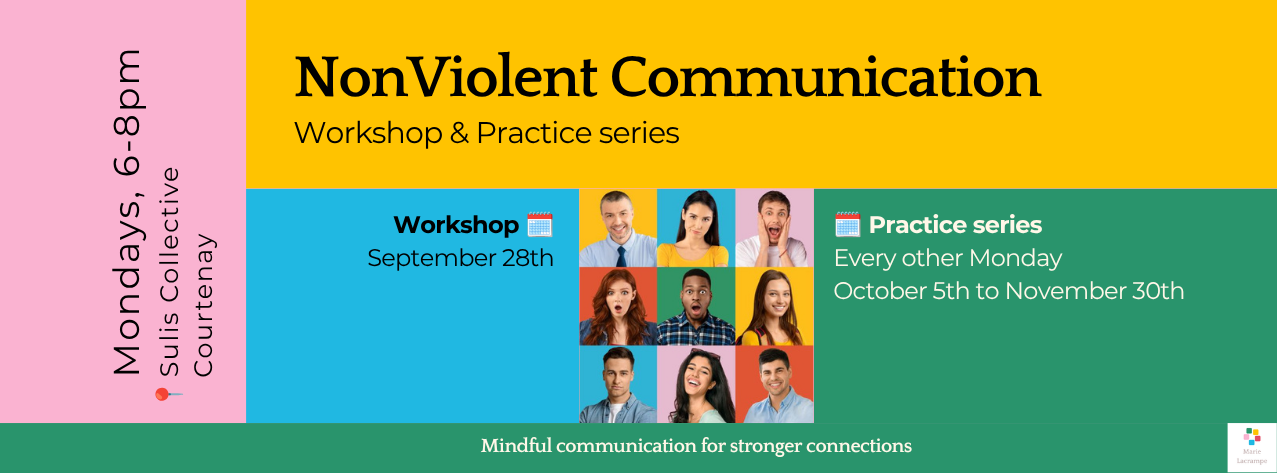
You can find all the practical information and details on the events page. If you want to know more about what the practice group looks like, keep reading!
Why join a practice group?
1 - Conflicts are a part of life, practice lessens the stress of it.
This summer, on a trip towards Port Renfrew, I was explaining NonViolent Communication to my 20 year old nephew. He asked me: "If everyone learned about NVC, would conflicts disappear?" The short answer I gave him is "no". Tensions, disagreements, and misunderstandings are a normal part of being in relationship with other humans, at home, at work, anywhere. NVC isn't about eliminating conflict, it's about having a way to move through it that maintains the connection.
The grass is greener on the other side of conflict
After you have addressed the tension, you create trust in the possibility to have difficult yet honest discussions. It also lessens the tension of the unsaid: all the thoughts that you keep for yourself are present every time you are with someone with whom you haven't had these discussions, like a ghost in the corner of the conversation.

Having those conversations is needed. Yet, it is difficult to do it because we are stressed out! And getting more at ease with tension, rehearsing what you want to say in a supportive environment is exactly what the practice group is about!
2 - Group practice gives you accountability and support.
Nobody expects to sit down and meditate perfectly after one introductory session. NVC works the same way. NonViolent Communication embeds a framework with four components: observations, feelings, needs, requests. It is fairly easy to write them on a whiteboard or reflect and journal after an event. What's hard is reaching for the skills, moments after something happens, like your partner or your colleague saying something that challenges you.
To make it possible to access the skills in real time, what we need is repetition, feedback, in a safe space where we can get it wrong a few times before it starts to feel natural. That's what the practice group is for: a small, consistent group where you try things out, stumble, get supportive feedback, and try again... until the skills start showing up on their own in your actual life.
The journey is messy, but it's well worth it and with the practice group, you are not travelling on your own.
3 - Be equipped for real-time discussions.
A lot of us have gotten used to running a hard message by ______ (replace with the AI tool you've been using) before we send it, or asking it to help us find the right words in a tense email. That works fine for a text message or any other asynchronous communication.
But it is obviously more difficult in the middle of a real conversation, whether it's at the dinner table, in a one-on-one with your manager, in the car with your kid. In those moments, you only have the tools you've actually practiced.
This series is about building that internal toolkit so it's there when you need it in real time, with real people, in real life.

Want to register?
See dates, pricing, and register for the next series