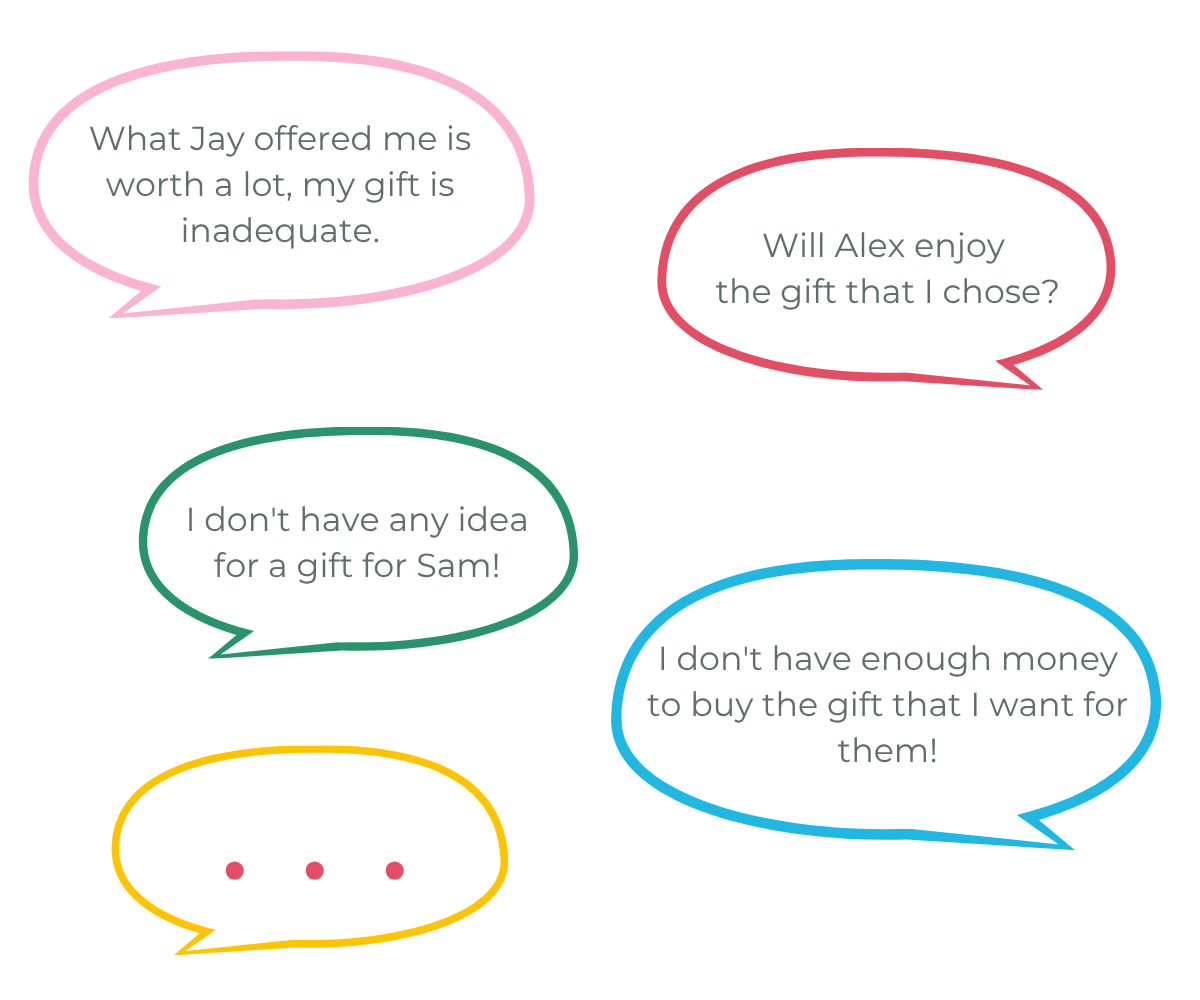
Family gatherings can be a moment that brings a lot of mixed feelings: there might be the joy of connecting with family, the tiredness of travelling as well as stress about gifts. And this last one comes in many flavours.
All these thoughts can prevent us from appreciating the moment. Fortunately, NonViolent Communication offers tools to help us prepare for these moments and fully enjoy them. How? By having conversations before the gathering to discuss together the way gift giving will happen. Even though it can feel stressful to open this discussion, it will help you release the tension you already feel. This article is a guide to help opening and navigating these discussions. Please consider everything written below as an invitation and adapt as you need to.
Self awareness
NonViolent Communication starts within us. Therefore, the first thing I invite you to do is to check in with yourself:
What are your observations? In the past, was there a situation where your gift was not appreciated? Did you see that the gift you gave cost less / more than the one from others?
In turn, how did you feel about it? Were you disappointed by how the gift was received? Did you feel anxious to see that the gift you received was more expensive than the one you had offered?
Deepening the reflection, what are someneeds that were not met in the situation? Was it about... care... appreciation... reciprocity... ease?
Getting more familiar with needs takes time and yet, they are the key to meaningful action. Being clear about the needs that are not met will give you a sense of direction when you have opened the discussion with others.
Once you are clear on your needs, sit with them for a moment. Feel the sensation that thinking about those needs, as if they were completely fulfilled, brings. You may start to think about ways to meet those needs. Write them down and try to refrain from acting right away. It's natural to want to get into action mode and yet, before that, you will want to prepare some more.
Perspective taking
Some of the thoughts that we have when if comes to gift giving can be about others: "I can't believe they bought such an expensive gift when they know I don't have the same means." "What? They didn't bring a gift at all!" "Who does that?".
These thoughts will get in the way of staying grounded and constructive during the discussion. Taking a moment to process them ahead of time will help you get a different perspective. This part is not about excusing something that has happened but freeing you from the tension that these thoughts bring in you by connecting with the humanity of the other person.
The self-empathy doner in the first part will support you in doing this second process, which is very similar: we will do the same steps from the perspective of the other person.
What could be their observations? Maybe they noticed this gift and thought it was such a great idea and it would please you so much, they got it without thinking about the price. Maybe they didn't bring a gift because they couldn't find something that they really trust would be a good fit for you.
And how could they be feeling? We are guessing here, trying as best as we can and holding those guesses lightly: they might be feeling excited for you to open the gift and see how thoughtful it is? Or maybe they are confident that you will understand that no gift is better than a gift that isn't great?
Continuing withneeds that they met with their actions: how about... love... care... understanding... excellence...?
If you feel resistance while doing this process, like thinking "Yes but...", circle back to the first part: you probably need more self-empathy.
As you identify needs that the other person tried to meet, you might find that some of the needs you uncover are the same as the ones you found for yourself. This is where we can see how we have different ways of meeting our needs and how sometimes it doesn't work for both.
Maybe your needs and theirs might be different and it's all right. In that case I invite you to think about how you also have those needs: don't you relate to a need for love, understanding or excellence (or other needs you identified)?
Now pause for a moment as you embrace the needs that you found for both: your needs and theirs. Does it give you a new perspective? Did you learn something about yourself, or them, in the process? Maybe some new ideas are coming up?
Connecting
Now that you have more clarity about your needs and the ones that others may have, you can open a conversation. The clarity that you gathered in the previous steps will help you find words that will connect you with others rather than propagating the tension that you were feeling.
Once you decide that it's time to have this conversation, make sure your intention is clear: am I trying to have a dialogue with everyone involved and create a solution collaboratively or do I have an ask?
If you feel like you want to enter a dialogue, share with everyone your intention. It might be unusual for your relatives to have this kind of conversation so you want to share as clearly as possible the fact that it's an invitation to a collaborative discussion, and not an intervention. It's about finding a way of doing things that works for everyone rather than demanding, about being open to talk about things that don't work rather than blaming each other.
The conversation can take many shapes: maybe it's one-on-one conversations followed by a recap for everyone, maybe it's a thread of emails, maybe it's a video conference call, maybe it's a group chat (although this last one is the most complicated).
Whatever the form you decide to go with, you want to make sure everyone is heard by asking people who are saying less to contribute to the discussion so that all the needs are gathered. Be sure to look for the needs behind the ideas that are shared to not let everyone be caught up in their thoughts and judgements.
In conclusion, how you prepare for the discussion is the most important part: holding space for everyone is not a small task. Discussing these topics and finding a way to make it work for everyone takes time so give yourself plenty of anticipation.
Need help?
It can be a lot to work on those topics on your own. Don't hesitate to book a coaching session to get clarity and support.